Intersectional violence
link theory, the coercion of women through animals, and the role of humane education
DOI:
https://doi.org/10.23925/ddem.v.2.n.14.71790Keywords:
Link Theory, Animal Law, Domestic Violence, Animal CrueltyAbstract
This article explores the Link Theory, which posits a significant correlation between animal cruelty and various forms of interpersonal violence, including domestic abuse, child maltreatment, and other violent crimes. Grounded in the work of Dr. Frank R. Ascione and recognized by institutions such as the FBI, the theory asserts that mistreatment of animals often precedes, coexists with, or signals violent behavior toward humans. Relevant data, including findings from the Military Police of São Paulo State, reveal recurrent patterns in both urban and rural contexts, showing a clear connection between domestic violence and animal abuse. One alarming statistic indicates that approximately 50% of women experiencing domestic violence report that their abusers have threatened, injured, or killed their companion animals as a form of emotional control. This analysis underscores the urgency of integrated actions, including humane education, public awareness, primary prevention policies, and the strengthening of multidisciplinary approaches. The methodology is based on a theoretical-reflective approach, supported by an interdisciplinary literature review that includes references from the fields of Law, Psychology, Veterinary Medicine, and Social Sciences, to understand the correlations between interpersonal violence and cruelty to animals. Understanding the link between violence against animals and interpersonal violence is essential to disrupting cycles of abuse and fostering a culture of peace and respect for all forms of life.
References
ARKOW, Phil. Linking animal cruelty and family violence. Animal Law Review, v. 25, p. 15–44, 2019.
ASCIONE, Frank R. Animal abuse and youth violence. Juvenile Justice Bulletin. Washington, DC: U.S. Department of Justice, 2001.
ASCIONE, Frank R. Battered women's reports of their partners' and their children's cruelty to animals. Journal of Emotional Abuse, v. 1, n. 1, p. 119–133, 1998.
ASCIONE, Frank R. Children who are cruel to animals: A review of research and implications for developmental psychopathology. Anthrozoös, v. 6, n. 4, p. 226–247, 1993.
ASCIONE, Frank R.; WEBER, Cathy V.; WOOD, David S. The abuse of animals and domestic violence: A national survey of shelters for women who are battered. Society & Animals, v. 15, n. 3, p. 205–218, 2007.
ATAIDE JUNIOR, Vicente de Paula. Educação animalista e animalitária. Jus Animalis, 2021. Disponível em: https://jusanimalis.com.br/direito-brasil/vicente-ataide-educacao-animalista-animalitaria. Acesso em: 20 abr. 2025.
BARROS, Janaína Vasconcelos de. Teoria do elo: relação entre as mulheres em situação de violência doméstica e a Medicina Veterinária. 2021. 64 f. Trabalho de Conclusão de Curso (Bacharelado em Medicina Veterinária) – Universidade Federal da Paraíba, Centro de Ciências Agrárias, Areia, 2021.
BESSA, Victoria Karoline Palheta. Teoria do Elo: a interligação da violência contra animais e mulheres. 2024. 42 f. Trabalho de Conclusão de Curso (Graduação em Medicina Veterinária) - Universidade Federal Rural da Amazônia, Campus Belém, PA, 2023.
BRASIL. Lei n. 11.340, de 7 de agosto de 2006. Cria mecanismos para coibir a violência doméstica e familiar contra a mulher. Diário Oficial da União: seção 1, Brasília, DF, 8 ago. 2006.
DEVINEY, Elisabeth; DICKERT, Jeffrey; LOCKWOOD, Randall. The care of pets within child abusing families. In: LOCKWOOD, Randall; ASCIONE, Frank R. (Ed.). Cruelty to animals and interpersonal violence. West Lafayette, IN: Purdue University Press, 1998. (Reimpresso do International Journal for the Study of Animal Problems, v. 4, 1983, p. 321–329.)
FEDERAL BUREAU OF INVESTIGATION. FBI tracks animal cruelty crimes. 2016. Disponível em: https://www.fbi.gov. Acesso em: 20 abr. 2025.
HELLMAN, Daniel S.; BLACKMAN, Nathan. Enuresis, firesetting and cruelty to animals: a triad predictive of adult crime. American Journal of Psychiatry, v. 122, n. 12, p. 1431–1435, 1966. DOI: https://doi.org/10.1176/ajp.122.12.1431. Disponível em: https://doi.org/10.1176/ajp.122.12.1431. Acesso em: 19 abr. 2025.
MARTINI, Sandra Regina; TAVEIRA, Élida Martins de Oliveira. Violência doméstica e familiar contra a mulher: uma abordagem a partir da metateoria do direito fraterno. Revista Direitos Democráticos & Estado Moderno, São Paulo, n. 2, p. 273–287, jan./jun. 2021. Disponível em: https://revistas.pucsp.br/index.php/DDEM/article/view/44160. Acesso em: 24 jun. 2025.
MERZ-PEREZ, Linda; HEIDE, Kathleen M.; SILVERMAN, Ira J. Childhood cruelty to animals and subsequent violence against humans. International Journal of Offender Therapy and Comparative Criminology, v. 45, n. 5, p. 556–573, 2001.
NARDI, Suzana Catanio dos Santos; BENETTI, Silvia Pereira da Cruz. Violência conjugal: estudo das características das relações objetais em homens agressores. Boletim de Psicologia, São Paulo, v. 62, n. 136, 2012. Disponível em: http://pepsic.bvsalud.org/scielo.php?script=sci_arttext&pid=S0006-59432012000100006&lng=pt&nrm=iso. Acesso em: 20 abril. 2025
NASSARO, Marcelo Robis Francisco. Maus-tratos aos animais e violência contra as pessoas: a aplicação da Teoria do Link nas ocorrências da Polícia Militar paulista. São Paulo: Polícia Militar do Estado de São Paulo, 2013.
PADILHA, Maria José Sales. Crueldade com animais x violência doméstica contra mulheres: uma conexão real. Recife: AADAMA, 2011.
SANTOS, Juarez Cirino dos. A criminologia radical. Curitiba: CPC: Lumen Juris, 2006, p. 13.
TALLICHET, Suzanne E.; HENSLEY, Christopher. Exploring the link between recurrent acts of childhood and adolescent animal cruelty and subsequent violent crime. Criminal Justice Review, v. 29, n. 2, p. 304–316, 2004. DOI: https://doi.org/10.1177/073401680402900203.
WEHNER, Caroline et al. Bringing light into the dark: associations of fire interest and fire setting with the Dark Tetrad. Frontiers in Psychology, v. 13, p. 1–13, 2022. DOI: https://doi.org/10.3389/fpsyg.2022.876575. Disponível em: https://www.frontiersin.org/articles/10.3389/fpsyg.2022.876575/full. Acesso em: 19 abr. 2025.
WILLIAMS, Joanne M.; WAUTHIER, L. M. Psychological risk factors for animal harm and abuse among children and young people. In: FERREIRA, G. M.; WILLIAMS, Joanne M. (Ed.). Understanding animal abuse and how to intervene with children and young people: A practical guide for professionals working with people and animals. New York: Routledge, 2023. p. 14–35. DOI: https://doi.org/10.4324/9781003165552-2.
WRIGHT, John; HENSLEY, Christopher. From animal cruelty to serial murder: Applying the graduation hypothesis. International Journal of Offender Therapy and Comparative Criminology, v. 47, n. 1, p. 71–88, 2003. DOI: https://doi.org/10.1177/0306624X02239276.
ZANONI, Erika. Participação no podcast Zona V Podcast. Episódio “Garoto de 9 anos dizima animais: doutora alerta”. Publicado em 22 out. 2024. Disponível em: https://www.youtube.com/watch?v=ljL05w1GgwM. Acesso em: 20 abr. 2025.
Downloads
Published
How to Cite
Issue
Section
License
Copyright (c) 2025 Democratic Rights & Modern State

This work is licensed under a Creative Commons Attribution 4.0 International License.

This work is licensed under a License Creative Commons Atribuição 4.0 Internacional.
The authors grant the journal all copyrights relating to the published works. The concepts issued in signed articles are the absolute and exclusive responsibility of their authors.
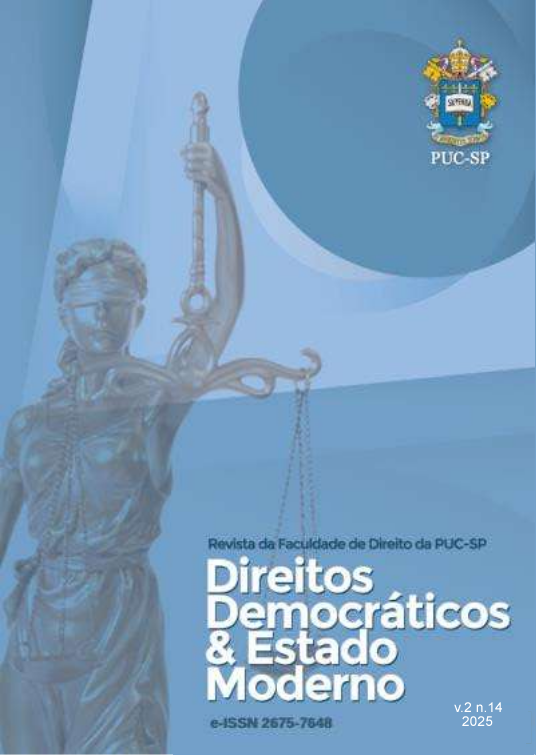
DD&EM Magazine - ISSN 2675-7648