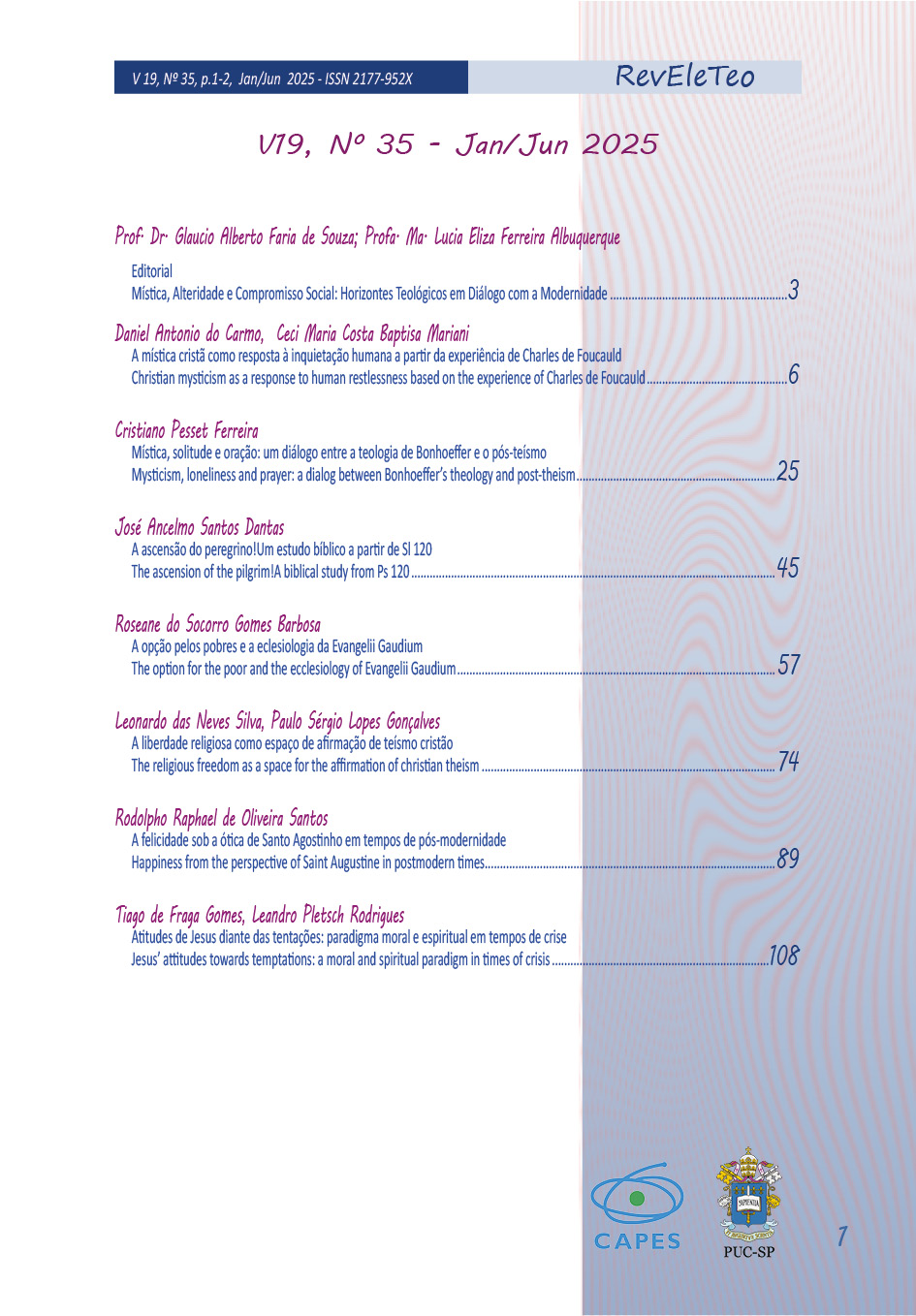
Atitudes de Jesus diante das tentações
Paradigma moral e espiritual em tempos de crise
DOI:
https://doi.org/10.23925/2177-952X.2025v19i35p108-135Palavras-chave:
Tentações, Jesus, Deserto, AutodomínioResumo
A presente pesquisa desenvolve-se a partir de uma abordagem teórico-bibliográfica, tendo como objeto as narrativas evangélicas sinóticas (Mt 4,1-11; Lc 4,1-13; Mc 1,12-13). O problema de pesquisa centra-se em compreender como as respostas de Jesus às tentações no deserto podem servir como modelo moral e espiritual para a humanidade contemporânea, especialmente em contextos de crise, nos quais os valores éticos e a estabilidade emocional estão ameaçados. A hipótese formulada propõe que as atitudes de Jesus configuram um paradigma de resistência fundamentado na obediência à vontade divina e no autodomínio, que promove uma liberdade interior capaz de sustentar a vida espiritual madura e equilibrada diante das adversidades. Os objetivos da investigação são, primeiramente, analisar o comportamento de Jesus diante de três tentações – satisfação imediata, busca pelo poder e autossuficiência –, evidenciando a centralidade da confiança na Palavra de Deus e na relação filial com o Pai; em segundo lugar, busca-se refletir sobre a atualidade desse paradigma moral e espiritual para o enfrentamento das crises contemporâneas, especialmente no que concerne à tentação do relativismo ético e à busca por soluções rápidas e superficiais. A pesquisa também almeja destacar a importância do sofrimento e da provação como elementos formativos do caráter humano, ressaltando que a resistência às tentações não consiste em rejeição dos bens ou da vida, mas em um exercício contínuo de discernimento e equilíbrio fundamentado na graça divina. Parte-se da premissa que o exemplo de Jesus no deserto permanece um guia para o cristão contemporâneo, pois indica que a superação das tentações e a construção do caráter moral são processos que envolvem abertura à graça, prática espiritual constante e autodomínio.
Downloads
Métricas
Referências
AGOSTINHO. A cidade de Deus. Trad. J. Dias Pereira. 5. ed. Lisboa: Fundação Calouste Gulbenkian, 2017.
AGOSTINHO. Confissões. Trad. J. Oliveira Santos; A. Ambrósio de Pina. São Paulo: Nova Cultural, 1999.
ANDRÉ BONA. Oneomania: entenda mais sobre a doença do consumismo. Disponível em: https://andrebona.com.br/oneomania-entenda-mais-sobre-a-doenca-do-consumismo/. Acesso em: 24 maio 2025.
BARCLAY, W. The Daily Study Bible: The Gospel of Matthew. Edimburgo, Escócia: Saint Andrew Press, 2004.
BBC BRASIL. O que a ciência sabe sobre o prazer. Disponível em: https://www.bbc.com/portuguese/noticias/2016/04/160321_prazer_ciencia_fn. Acesso em: 24 maio 2025.
BECK, Randy. God the judge and human justice. Journal of Law and Religion: Center for the Study of Law and Religion at Emory University, v. 32, n. 1, p. 33-39, 2017.
BLOOM, Paul. Como o prazer funciona: por que gostamos do que gostamos. Rio de Janeiro: Best Seller, 2021.
BOOR, Werner de. Cartas aos Efésios, Filipenses e Colossenses: Comentário Esperança. Curitiba, PR: Editora Evangélica Esperança, 2006.
BRYAN, D. The Centre of Luke’s Temptation Narrative. The Catholic Biblical Quarterly, v. 82, n. 3, p. 407-423, 2020.
EXAME. O mapa para evitar brigas por herança. Disponível em: https://invest.exame.com/mf/o-mapa-para-evitar-brigas-por-heranca. Acesso em: 24 maio 2025.
FERREIRA, Aurélio Buarque de Holanda. Mini Aurélio Século XXI Escolar. Rio de Janeiro: Nova Fronteira, 2001.
FILLION, L. C. Enciclopédia da Vida de Jesus. Rio de Janeiro: Central Gospel, 2008.
FOUCAULT, Michel. Microfísica do Poder. Rio de Janeiro, RJ: Graal, 2001.
FROMM, Erich. Ter ou ser? Uma introdução ao pensamento humanista. 4. ed. Rio de Janeiro: Zahar editores, 1982.
GASHUTE, Abyot S. An Examination of the Use of Old Testament Scriptures in the Temptation Narrative in Matthew 4:1–11. ShahidiHub International Journal of Theology & Religious Studies, v. 5, n. 1, p. 64-83, 2025.
GIOIA, Egidio. Notas e Comentários à Harmonia dos Evangelhos. Rio de Janeiro: JUERP, 1969.
GIRARD, René. A violência e o sagrado. Trad. Martha Conceição Gambini. São Paulo: Paz e Terra, 2008.
GIRARD, René. Coisas ocultas desde a fundação do mundo. Trad. Martha Conceição Gambini. São Paulo: Paulus, 2005.
GIRARD, René. Mentira romântica e verdade romanesca. Trad. Paulo Neves. São Paulo: É Realizações, 2012.
KRINGELBACH, Morten L.; BERRIDGE, Kent C. Pleasures of the brain. New York: Oxford University Press, 2010.
LAURENCE, R. V. Power tends to corrupt, and absolute power corrupts absolutely in such manner that great men are almost always bad men. Historical Essays and Studies. London: Macmillan, 1907.
LE BON, Gustave. The Psychology of Revolution. Auckland, New Zealand: The Floating Press, 2013.
LIFE DN. Poder sobe mesmo à cabeça segundo as neurociências. Disponível em: https://life.dn.pt/poder-sobe-mesmo-cabeca-segundo-as-neurociencias/comportamento/340080/. Acesso em: 24 maio 2025.
LINDEN, David J. The compass of pleasure. New York: Viking, 2011.
MARTINS, Yves Gandra da Silva. Uma breve teoria do poder. 4. ed. São Luís, Maranhão: Livraria Resistência Cultural Editora, 2021.
REED, Oscar F. (Org.). Comentário Beacon. Rio de Janeiro, RJ: CPAD, v. 6, 2006.
SCHIAVO, Luigi. A Apocalíptica Judaica e os Surgimentos da Cristologia de Exaltação na Narrativa da Tentação de Jesus (Q 4,1-13). Orácula, São Bernardo do Campo, v. 1, n. 1, p. 98-148, ago./set. 2005.
SILVA, D. N. da. A propensão humana para o pecado e as tentações de Cristo. Práxis Teológica, v. 4, n. 1, jan./jun. 2000.
SOUZA, Ronaldo Rodrigues (Ed.). Comentário Bíblico de Matthew Henry: Mateus a João. Rio de Janeiro, RJ: CPAD, v. 5, 2008.
TOMÁS DE AQUINO. Suma Teológica. Trad. bilíngue (português/latim), v. I–IX. Joaquim Pereira; Carlos Josaphat Pinto de Oliveira (Orgs.). 3. ed. São Paulo: Loyola, 2006.
VELOSO, Mario. Mateus: contando a história do Rei Jesus: comentário bíblico homilético. 2. ed. Tatuí, SP: Casa Publicadora Brasileira, 2011.
WHITE, Ellen G. Nossa Alta Vocação. Tatuí, SP: Casa Publicadora Brasileira, 1962.
WHITE, Ellen G. O Desejado de todas as nações. Tatuí, SP: Casa Publicadora Brasileira, 2003.
WIERSBE, Warren W. Comentário Bíblico Expositivo. Santo André, SP: Geográfica, v. 2, 2007.