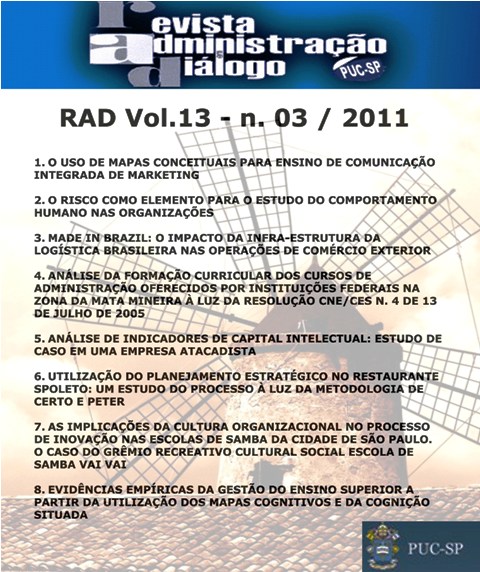
EMPIRICAL EVIDENCE OF HIGHER EDUCATION MANAGEMENT FROM THE USE OF COGNITIVE MAPS AND SITUATED COGNITION
DOI:
https://doi.org/10.20946/rad.v13i3.7800Keywords:
Cognitive Maps, Situated Cognition, Higher EducationAbstract
In the era of knowledge, institutions of higher education in private practice need knowledge and applied that lead to the construction of new managerial models. Based on this aspect, the article lecture contextualize how cognitive maps can contribute to the development of practice learning within the context of these management institutions. The theoretical discussion lists related terms to understanding the organization from an analogy with the human brain and the assumptions that inform the construction of competitive intelligence. Similarly, promotes reflection on the structure of cognitive maps and their construction maiêutica to promote the construction of knowledge. For this, the methodological foundations are focused on the systematic review procedures described in classifying and summarizing data collected through the database Scopus and Google Scholar published between the years 2000 and 2010. Among other things, allow the results of syntheses highlight the collaboration of cognitive maps from a rhetoric focused on cognition and situated learning, towards constructive and structuring a specific knowledge to the management of higher education institutions in the private sphere.Downloads
Metrics
Downloads
How to Cite
Issue
Section
License
Authors who publish in this journal agree to the following terms:
1. Authors retain the copyright and grant the journal the right of first publication, with the work licensed simultaneously under a Creative Commons Attribution License after publication, allowing the sharing of work with acknowledgment of the authorship of the work and initial publication in this journal.
2. Authors are authorized to take additional contracts separately, for non-exclusive distribution of the version of the work published in this journal (eg publish in institutional repository or as a book chapter), with acknowledgment of authorship and initial publication in this journal.
3. Authors are allowed and encouraged to publish and distribute their work online (eg in institutional repositories or on their personal page) at any point before or during the editorial process, as this can generate productive changes, as well as increase the and the citation of the published work (See The Effect of Free Access).