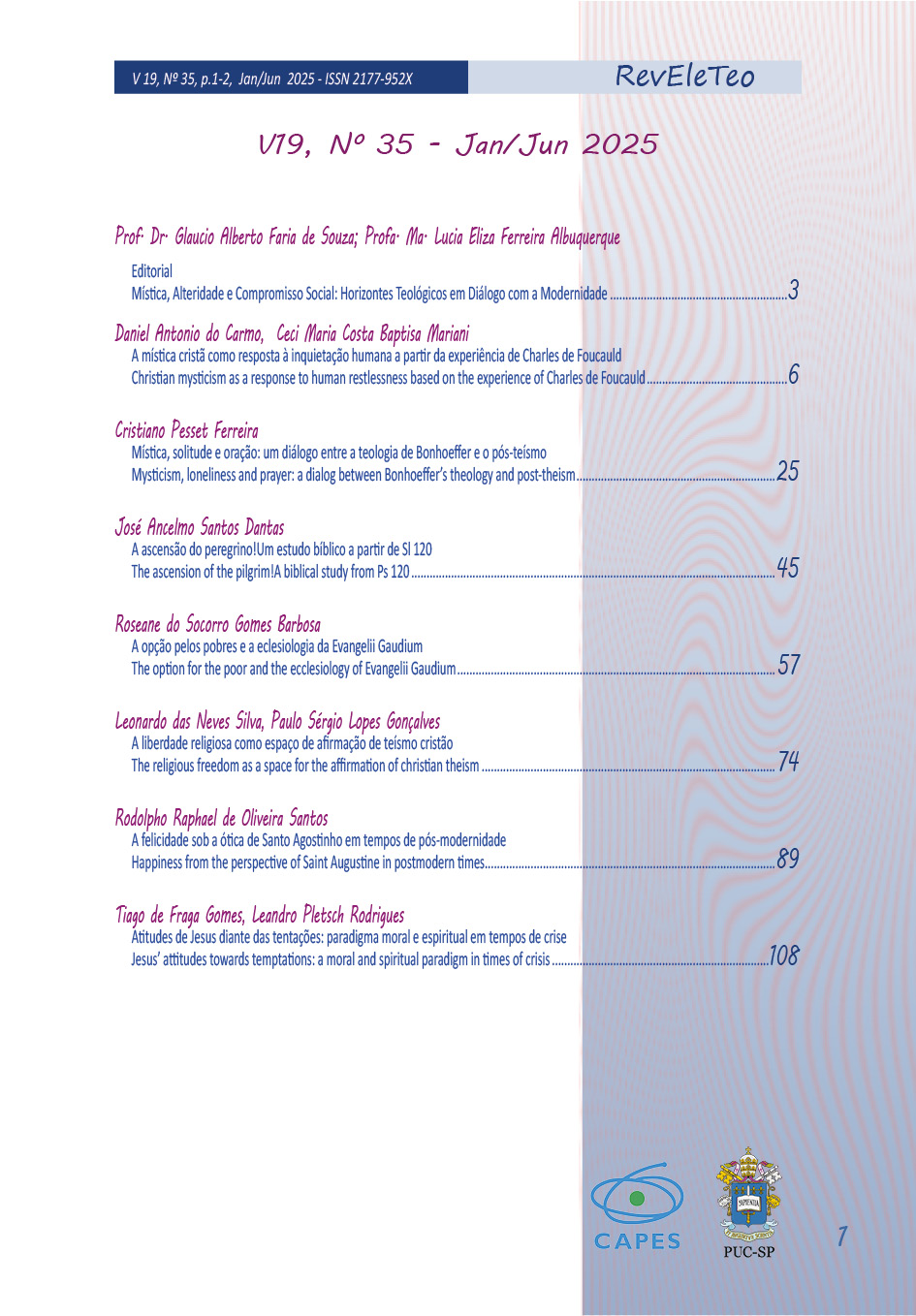
The religious freedom as a space for the affirmation of christian theism
DOI:
https://doi.org/10.23925/2177-952X.2025v19i35p74-88Keywords:
Religious freedom, human dignity, religious theism, religionsAbstract
This article aims to analyze the issue of religious freedom based on the Declaration Dignitatis Humanae, a document from the Second Vatican Council. This Declaration is one of the most significant documents of the Second Vatican Council, an ecclesial event that placed the Church in deep dialogue with modernity, a status spiritualis that allows the emergence of the modern subject with its respective freedoms, including religious freedom, bringing to light the “freedom of freedoms” and religious pluralism. The Declaration recognizes religious freedom based on the dignity of the human person, highlighting it as a fundamental right with legal, social, anthropological, and religious implications. The research was developed through a methodology comprising reading, description, and analysis of fundamental texts. Initially, an analysis of the historical context and structure of the Dignitatis Humanae Declaration was conducted, including its relationship with other documents from the Second Vatican Council, considering three fundamental dimensions: historical, anthropological-philosophical, and theological. Subsequently, the key points of religious freedom were systematically analyzed, both philosophically and theologically, using texts from relevant commentators. The proposed analysis revealed that the conciliar approach to religious freedom transcends mere religious tolerance, previously admitted by the ecclesial magisterium. The research identified the need for a hermeneutical leap, allowing new possibilities for dialogue in the face of religious pluralism. Additionally, drawing from the Spanish thinker Xavier Zubiri, religious freedom was analyzed as a possibility for the affirmation of Christian theism. In summary, the research argues that the theme of religious freedom is complex and its implications are vast, spanning historical, philosophical, anthropological, and theological dimensions across the scenarios of humanity, timelessly.
References
ALBERIGO, Giuseppe (org.). História dos Concílios Ecumênicos. São Paulo: Paulus, 1995.
BENTO XVI. Exortação Apostólica Ecclesia In Medio Oriente, 2012. Disponível em: https://www.vatican.va/content/benedict-xvi/pt/apost_exhortations/documents/hf_ben-xvi_exh_20120914_ecclesia-in-medio-oriente.html. Acesso em: 28 jan 2024.
CONCÍLIO VATICANO II. Declaração Dignitatis Humanae. Sobre a Liberdade Religiosa, 1965. Disponível em: https://www.vatican.va/archive/hist_councils/ii_vatican_council/documents/vat-ii_decl_19651207_dignitatis-humanae_po.html. Acesso em: 05 set 2023.
FAVRETTO, Alexandre Boratti. Liberdade Religiosa na Declaração Dignitatis Humanae: Contexto, gênese temática e debate. São Paulo: Pluralidades, 2022.
FRANCISCO. Exortação Apostólica Evangelii gaudium, 2013. Disponível em: https://www.vatican.va/content/francesco/pt/apost_exhortations/documents/papa-francesco_esortazione-ap_20131124_evangelii-gaudium.html. Acesso em: 28 jan 2024.
GONÇALVES, Paulo Sérgio Lopes. Diversidade Religiosa em Xavier Zubiri. Revista Eclesiástica Brasileira (Reb), Petrópolis, v. 83, n. 326, p. 665-683, 2023. Disponível em: https://revistaeclesiasticabrasileira.itf.edu.br/reb/article/view/5221/4709. Acesso em: 10 jul. 2024.
GONÇALVES, Paulo Sérgio Lopes; FAVRETTO, Alexandre Boratti. A liberdade religiosa na Declaração Dignitatis Humanae: elementos para uma nova teologia das religiões e para uma inserção da religião no espaço público. Atualidade Teológica, Rio de Janeiro, v. 2016, n. 3, p. 664-685, 21 nov. 2016. Faculdades Católicas. Disponível em: https://www.maxwell.vrac.puc-rio.br/27897/27897.PDF. Acesso em: 28 jan 2024.
JOÃO XXIII. Discurso na abertura solene do SS. Concílio, 1962. Disponível em: https://www.vatican.va/content/john-xxiii/pt/speeches/1962/documents/hf_j-xxiii_spe_19621011_opening-council.html. Acesso em: 28 out 2023.
KLOPPENBURG, Frei Boaventura. Concílio Vaticano II. v. 1-5. Petrópolis: Vozes, 1962-1966.
O’MALLEY, John W. O que aconteceu no Vaticano II. São Paulo: Edições Loyola, 2014.
PINTOR-RAMOS, Antonio. Uma filosofia da religião cristã. In: SECRETAN, Philibert (org.). Introdução ao Pensamento de Xavier Zubiri, Coleção Filosofia Atual. São Paulo: É Realizações, 2014, p. 79-82.
SOUZA, Ney de. A liberdade religiosa e função pública das religiões. In: ROSSI, L.A.; JUNQUEIRA, S. (orgs.). Religião, Direitos Humanos & Laicidade. Curitiba: Fonte Editorial, 2015. p. 153-162.
THEOBALD, Cristoph. A recepção do Concílio Vaticano II. Volume I: Acesso à fonte. São Leopoldo: Unisinos, 2015. Tradução de: Paulo Neves.
VATICAN NEWS. “Dignitatis Humanae”: assim o Concílio sancionou o direito à liberdade religiosa. 2020. Disponível em: https://www.vaticannews.va/pt/vaticano/news/2020-06/dignitatis-humanae-declaracao-conciliar-historia-igreja.html. Acesso em: 08 maio 2023.
VATICAN NEWS. O Papa: liberdade religiosa é valorizar os irmãos em suas diferenças. 2022. Disponível em: https://www.vaticannews.va/pt/papa/news/2022-01/papa-francisco-intencao-oracao-janeiro-liberdade-religiosa.html. Acesso em: 08 maio 2023.