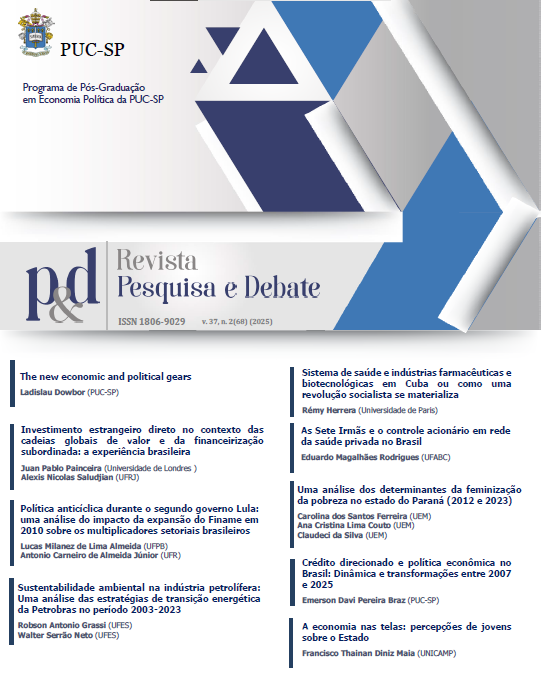
Health System and Pharmaceutical and Biotechnology Industries in Cuba or How a Socialist Revolution Takes Shape
DOI:
https://doi.org/10.23925/1806-9029.37in.2(68)74193Keywords:
Public health, Medical research, Pharmaceutical industries, Biotechnologies, Socialism, CubaAbstract
This article explains how the Cuban Revolution managed to build, from an unfavorable situation in a small southern country with no natural resources—and under US sanctions—a comprehensive, universal, efficient, and free public health system. It examines the origin and development of local pharmaceutical and biotechnology industries, as well as the main players in medical research and their recent advances, as well as Cuba’s international cooperation in medical matters, and its international health missions. It also analyzes the measures taken on the island by health authorities against the Covid-19 pandemic, the originality of health and research systems within the framework of a socialist society, and how they face problems that are largely attributable to the US embargo.
References
AGRESIONES DE ESTADOS UNIDOS a Cuba: 1787-1976. Havana: Editorial de Ciencias Sociales, 1979.
ÁLVAREZ, E.; MÁTTAR, J. Política social y reformas estructurales. Mexico: CEPAL-INIE-PNUD, 2004.
AMERICAN ASSOCIATION OF WORLD HEALTH. The impact of the US embargo on health and nutrition in Cuba. Washington, D.C.: American Association of World Health, 1997.
CABRERA, M. La Ciencia desnuda un crimen contra Cuba. Revista Bohemia, Havana, 29 jan. 2016.
CAMPBELL, A. Cuba’s economic and political reforms, in the frame of Marx and Engels’ concept of socialism. In: Séminaire Marx au XXIe siècle, Université Paris 1 Panthéon-Sorbonne, Paris, dez. 2022.
COMMISSION ON CUBAN AFFAIRS. Problems of the new Cuba. Nova Iorque: Foreign Policy Association, 1935.
FERRIOL, Á. et al. Cuba: crisis, ajuste y situación social. Havana: Editorial de Ciencias Sociales, 1998.
GAFFIOT, F. Dictionnaire Latin-Français. Paris: Hachette, 1934.
HERRERA, R. A people’s history of Cuba: 1492-present. Nova Iorque: Palgrave Macmillan, 2025. (Coleção Global University for Sustainability)
IBRD (INTERNATIONAL BANK FOR RECONSTRUCTION AND DEVELOPMENT). Report of the mission in Cuba. Washington, D.C.: Bureau of the President, 1951.
KHIDER, M. Médecins cubains, les armées de la paix. Paris: LGM Éditions, 2021.
MARTÍNEZ MARTÍNEZ, O. Desarrollo humano: la experiencia cubana. Revista Cuba Económica, Havana, v. 1, n. 1, p. 16-34, 1991.
MINREX (MINISTERIO DE RELACIONES EXTERIORES). Informe de Cuba sobre el bloqueo de EEUU contra Cuba. Havana: Representaciones Diplomáticas de Cuba en el Exterior, 19 out. 2022.
MINSAP (MINISTERIO DE SALUD PÚBLICA DE CUBA). Anuario estadístico de salud 2020. Havana: Dirección de Registros Médicos y Estadísticas de Salud, 2021.
MINSAP (MINISTERIO DE SALUD PÚBLICA DE CUBA). Anuario estadístico de salud. Havana: Dirección de Registros Médicos y Estadísticas de Salud, vários anos.
ONEI (OFICINA NACIONAL DE ESTADÍSTICAS E INFORMACIÓN). Anuario estadístico de Cuba. Havana: ONEI, vários anos.
RODRÍGUEZ GARCÍA, J.; CARRIAZO MORENO, G. Erradicación de la pobreza en Cuba. Havana: Editorial de Ciencias Sociales, 1987.
UNDP (UNITED NATIONS DEVELOPMENT PROGRAMME). Human development report. Nova Iorque: UNDP, 1996.
UNESCO (UNITED NATIONS EDUCATIONAL, SCIENTIFIC AND CULTURAL ORGANIZATION). Annual statistical tables. Paris: UNESCO, 1997.
UNESCO (UNITED NATIONS EDUCATIONAL, SCIENTIFIC AND CULTURAL ORGANIZATION). World science report. Paris: UNESCO, 1998.
UNICEF (UNITED NATIONS INTERNATIONAL CHILDREN’S EMERGENCY FUND). Statistical tables. Nova Iorque: UNICEF, 1998.
WHO (WORLD HEALTH ORGANIZATION). Annual world health statistics. Genebra: WHO, vários anos.
WORLD BANK. World development indicators. Washington, D.C.: World Bank, 2024. Disponível em: https://data.worldbank.org/country/cuba. Acesso em: jul. 2025.
YAFFE, H. Cuba’s biotech revolution. Glasgow: Universidade de Glasgow, 2019. Documento de trabalho.
Downloads
Published
How to Cite
Issue
Section
License
Copyright (c) 2025 Research & Debate Journal of the Postgraduate Program in Political Economy

This work is licensed under a Creative Commons Attribution 4.0 International License.